
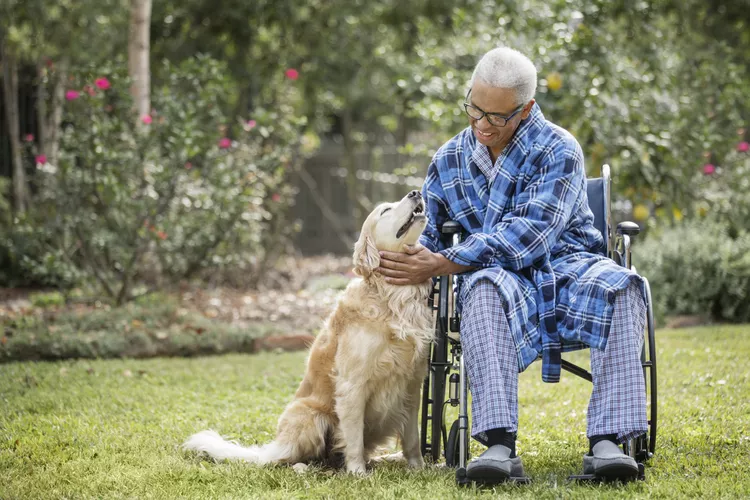
Therapy dogs bring comfort and joy to people in hospitals, nursing homes, and other community residences. Training your dog to serve as a therapy dog may be possible and would be a great way to give back and spread smiles. Any breed of dog—large and small—can take on this important role.
Learn the steps required to train and certify a therapy dog.
- 01 of 06
Enroll in the AKC Good Citizen Program
A great way to begin your exploration of therapy training is to participate in the AKC Canine Good Citizen Program (CGC). This certification shows that your dog is socialized, friendly, and has adequate basic training. In fact, CGC certification is a prerequisite for many therapy dog programs.
Therapy dogs work with a dedicated handler. Often, this is the dog's owner, but that's not always the case. You might, for instance, think your dog would be a great therapy dog but don't feel you have the time to dedicate to it yourself. In this instance, another handler can take your dog through the program instead.
- 02 of 06
Complete a Therapy Dog Training Program
After finishing the Canine Good Citizen test, your dog should be ready to begin targeted training for therapy. Among other training requirements, to succeed in a therapy setting, your dog must be able to:
- Stay relaxed and happy amid unfamiliar surroundings and people
- Calmly tolerate unexpected noise and movement
- Ignore distractions
- Readily focus on its handler and obey commands, including:
- Watch me
- Leave it
- Go through
- Follow
- Under
- Get drink
- Quiet
"Depending on the program, the specific command word may vary," explains Dr. Lindsay Livengood, Program Director and behavioral consultant. "However, the commands must remain consistent within each program and within each dog."
You may wish to find a therapy dog training class run by an experienced, knowledgeable dog trainer. Pet Partners offers home-study courses and workshops for both therapy dogs and their human handlers.
- 03 of 06
Find a Therapy Dog Registration Program
While you are training your dog to become the ideal therapy dog, start researching official animal-assisted therapy organizations. Two internationally recognized groups are Pet Partners and Therapy Dogs International.
Keep in mind that each animal-assisted therapy group is a little different. Learn about the groups and find out which seem to be the best fit for you and your dog. Each group has its own set of standards, required courses, and special testing before a dog and handler can become a registered therapy team.
- 04 of 06
Document Your Dog's Health
Therapy dogs must meet specific health requirements, for both their safety and that of the people they will visit. At the very least, your dog should have current vaccinations, be on routine heartworm prevention, and have a clean bill of health from your veterinarian. Dogs fed a raw diet are not allowed to participate in some programs.
Continue to 5 of 6 below - 05 of 06
Complete the Final Evaluation Process
Once a dog and its handler complete all the requirements, they must go through a final evaluation, or series of evaluations, to become an official animal-assisted therapy team. The process can be very involved and sometimes quite difficult. However, many dedicated handlers and their dogs find that it is all well worth it in the end.
- 06 of 06
Schedule Your First Visit
Once you and your dog are a certified therapy team, you can begin visiting facilities scheduled through your chosen organization. This is the ultimate test of your dog's behavior in real-world settings.
After you get out there and start making a difference, you'll be glad you took the time to go through the process. You and your well-trained pup will bring smiles to countless faces and help cheer up people who may need it most.
Therapy Dog Disqualificaitions
As much as you may hope that your pup becomes an amazing therapy dog, not all dogs will make the cut. Each dog is different, so don't be disappointed if yours doesn't make it through training.
Sometimes it's found during training that a dog does not have the right temperament or attention span to handle the job. It's also common to find dogs that may not have the desire to spend that much time with strangers or become easily startled in certain environments.
While any dog may have the "right stuff" to become a therapy dog, experts from the internationally recognized Support Dog Certification registry advise that certain breeds are best suited to the job.
These include:
- Golden retriever
- Poodle
- Labrador retriever
- Cavalier King Charles spaniel
- Pug
- German shepherd
- Beagle
- Greyhound
- Saint Bernard
-
Do therapy dogs have to be AKC registered?
To become an AKC Therapy Dog, therapy dogs must be registered with the American Kennel Club. But it's not the only therapy dog certification program out there.
-
What do you need to be a therapy dog in NY?
According to the state of New York, therapy dogs must be licensed as required by Article 7 of New York State Agriculture and Markets Law. Dogs should also be registered with a therapy dog organization whose standards are consistent with these guidelines.
-
Can you make money from a therapy dog?
There are some paid opportunities for therapy dogs and their handlers, but most opportunities are volunteer.