
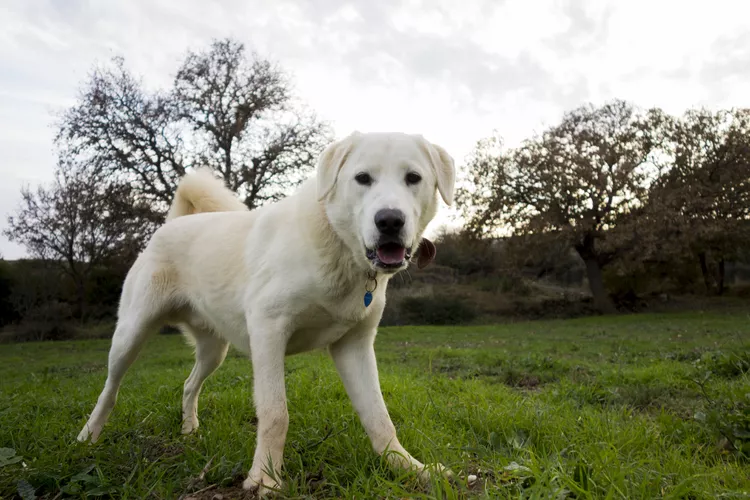
The akbash is a large guardian dog breed from Turkey with a white coat that comes in medium and long lengths. The breed closely resembles the more common Great Pyrenees. It features a wedge-shaped head with dark eyes and triangular drop ears. And its long tail often curls up and over the dog’s back. Plus, the breed’s long legs allow it to move swiftly, and it has loose skin around its neck that helps to protect it from attacks. That serves the akbash well in its role defending livestock from wolves and other predators.
Breed Overview
Group: Guardian Dog (United Kennel Club)
Height: 28 to 32 inches (female), 30 to 34 inches (male)
Weight: 90 pounds (female), 120 pounds (male)
Coat: Medium to long double coat
Coat Color: White, light biscuit or gray shading acceptable
Life Span: 10 to 12 years
Temperament: Alert, independent, courageous
Hypoallergenic: No
Origin: Turkey
Characteristics of the Akbash
The akbash generally has an independent and watchful temperament. Even though it’s quite intelligent, it can be difficult to train due to its self-governing personality. The breed also has strong protective instincts and will bark at—and potentially become aggressive with—perceived threats.
History of the Akbash
The akbash’s origin is unclear, as its ancestors date back thousands of years in Turkey. It’s possible that it has some mastiff and sighthound breeds in its mix.
The breed long has been used as a livestock guardian in part because its white coat allows it to blend in with flocks of sheep and other animals, giving it the element of surprise if a predator were to draw near. However, it is not a herding dog. The breed tends to be territorial and wary of strangers, and it will calmly lie among its flock scanning for danger.
The akbash began to gain a foothold in the United States in the 1970s, though it’s still a very rare breed. The American Kennel Club does not yet recognize it. But the United Kennel Club does classify it as part of its Guardian Dog Group.
Akbash Care
The akbash doesn't require a great deal of exercise, and its grooming is fairly straightforward, though it can shed a lot. But you will have to put some time and effort into training and socialization to ensure that you have a well-mannered dog.
Exercise
Because the akbash is a guardian dog and not a herding dog, it doesn’t have extreme exercise requirements. These dogs don’t have to run around gathering and moving livestock, but rather they watch over their herd from a comfortable vantage point. Aim for at least an hour per day of exercise to keep your akbash healthy. Walking, jogging, and hiking all are ideal ways to get some energy out. Puzzle toys can challenge your akbash’s mind as well, though this isn’t an overly playful breed.
Grooming
Brush your akbash at least weekly to remove loose fur and prevent tangles and mats. Pay special attention to areas of the coat with feathering, which can tangle easily. Expect periods of higher shedding twice a year in the spring and fall. You might have to brush daily to keep up with the loose fur during those times.
Bathe your akbash about once a month, depending on how dirty it gets. Check your dog’s ears weekly for dirt, wax buildup, and other abnormalities. In addition, check its nails monthly to see whether they need a trim. Aim to brush its teeth daily.
Training
Begin training and socializing your akbash when it’s a puppy to instill good behaviors and prevent bad habits from forming. The breed’s independent and stubborn nature can make training difficult, even though it is quite smart and can understand commands. Always use positive-reinforcement training methods, such as treats and praise. And be consistent in the behavior you expect when you give a command.
Give your akbash lots of positive experiences around new people and other dogs, as well as in various locations from an early age. This can help to curb its protective and territorial nature. However, that instinct is difficult to fully quell, so you’ll likely have to exercise caution when your akbash is meeting strangers and even other dogs.
Common Health Problems
The akbash is overall a healthy dog, though it is prone to some hereditary health issues, including:
- Hip dysplasia
- Cruciate ligament injuries
- Hypothyroidism
- Dilated cardiomyopathy
- Gastric dilatation volvulus (bloat)
- Cancer
- Kidney disease
- Epilepsy
Diet and Nutrition
Always make sure your akbash has access to fresh water. You might want to get a large water bowl for this big breed. Feed it a quality, nutritionally balanced canine diet. A food formulated especially for large breeds might be beneficial. But you should always discuss both the diet type and the amount with your vet.
It’s typical to feed two measured meals per day. But the akbash is a breed that’s prone to bloat and potentially life-threatening stomach twisting, which can arise from eating too quickly. Feeding smaller, more frequent meals can help to prevent this, along with keeping your dog calm around mealtimes.
Where to Adopt or Buy an Akbash
The akbash is a rare dog breed. It’s not easily found at animal shelters and rescues, though it’s still worth checking. You also might have trouble locating a breeder, depending on where you live. A puppy from a reputable breeder can cost around $600 to $2,000 on average.
For further information to help you find an akbash, check out:
Akbash Overview
Good watchdog
Doesn't need lots of exercise
Typically loyal and devoted to family
Can be stubborn about training
Territorial and often wary of strangers
Goes through periods of high shedding
More Dog Breeds and Further Research
Before bringing home an akbash, do thorough research to ensure that the breed is right for your lifestyle. Talk to akbash owners, rescue groups, responsible breeders, and veterinary professionals. Try to spend some time around the breed, too, if you can.
If you’re interested in similar breeds, check out:
There’s a whole world of potential dog breeds out there—with a little research, you can find the right one to bring home!
-
What's the difference between an akbash and a Great Pyrenees?
The akbash and Great Pyrenees look quite similar at first glance, thanks to their shaggy white coats and large stature. They both are watchful guardians as well. But the akbash is generally less social and active than the Great Pyrenees, and it has a slightly leaner build.
-
Is the akbash aggressive?
Even when well trained and socialized, the akbash has a strong protective instinct. It will aim to intimidate perceived threats by posturing and barking, and this might lead to aggression if the threat persists.
-
Is the akbash rare?
The akbash is a rare dog breed, especially in North America. It isn't recognized by the American Kennel Club, though the United Kennel Club does list it as a breed.