
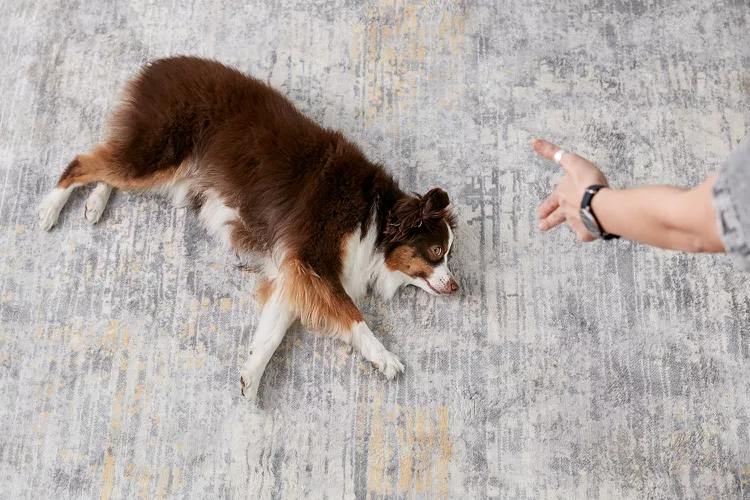
Playing dead is a great dog trick. While it's not as important as teaching your dog to obey commands like "sit" and "stay," it can be a fun game for both the dog and its audience. If your dog knows the "lie down" command, then playing dead should be easy.
All you need is a handful of tasty treats, and you are ready to start training your dog to play dead. This is a great trick to teach by clicker training route, so be sure to have your clicker handy.
How to Train Your Dog to Play Dead
4 Steps to Teach Your Dog to Play Dead
- Start in a Down Position: Command your dog to lie down. (If your dog doesn't lie down on command yet, go back and master that before you begin training it to play dead.)
- Offer a Treat: Hold a treat close to your dog's nose, and slowly pull it over to its side so it will have to roll onto its side to get it. This step is a lot like teaching your dog to roll over. If your dog already knows this trick, then it's ahead of the game.
- Reward Listening: As soon as your dog is lying on its side, say "yes" or "good." Or, click your clicker. Then, give the dog a treat. Repeat these steps several times.
- Add a Signal: After your dog completes the roll a few times, add a cue word and a hand signal. Most people choose to use the verbal command "bang" along with a hand signal command, holding their fingers to look like a gun pointing at the dog. Others ask a funny question like, "Would you rather be a cat, or be dead?" Whatever command you choose, say the phrase, show the dog your hand signal, and then offer the treat on the floor beside the dog. Eventually, you will stop placing the treat on the floor and reward the dog after it "revives" instead.
Problems and Proofing Behavior
If your dog already knows how to roll over, its natural inclination might be to go all the way over when you start to lure it to its side. This is a great time to get your clicker out to capture the exact behavior you want.
- Lure your dog onto its side with a treat, click your clicker immediately, and give the dog a treat. If it tries to keep rolling over, step away for a minute. When your dog realizes that the treat disappears when it rolls completely over, it will stop.
If you are having trouble getting your dog to follow the treat so that it ends up lying on its side, you can help by physically moving the dog.
- Gently push the dog over onto its side. As soon as the dog is in the correct position, click your clicker (or tell him "yes" or "good") and offer a treat.
If at any point in the training, your dog makes more than two or three mistakes in a row, you may be moving ahead too quickly. Go back a step or two and practice. When the dog is repeatedly successful at the earlier step, begin the next step.
Remember to be patient and consistent. Each dog is unique and learns at a different pace. Keep training sessions upbeat and stop training if your dog seems frustrated, tired, or bored. Always try to end sessions on a positive and successful note, even if that means switching to a simpler action like "sit" or "down" as the last thing you do.